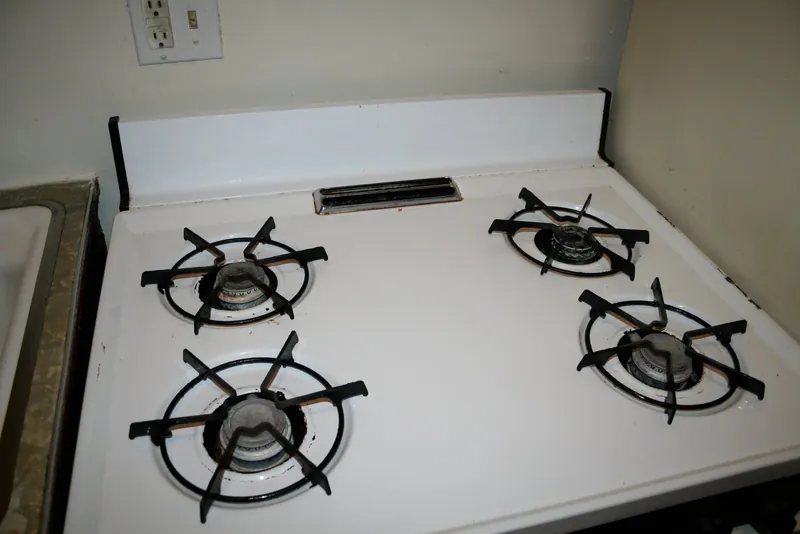
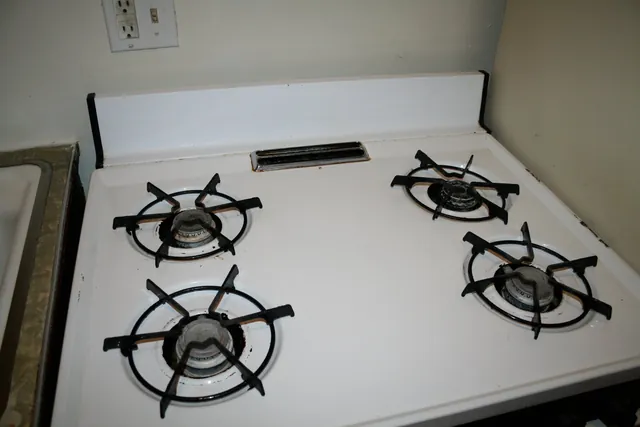
A gas cooktop lights with spark ignition. Turning any knob to LITE closes a small switch on that valve, which tells a spark module to send high-voltage pulses to a ceramic electrode beside each burner. On most models every electrode clicks at once, and that is normal. Gas passes through the valve to a small orifice, mixes with air and leaves through ports in the burner head, under a loose cap that spreads the flame. Most gas-top trouble lives right there: a cap sitting crooked, ports clogged by a boil-over, an electrode cracked or coated in grease, a valve switch that got wet during cleaning and now clicks nonstop. Spark modules and valves fail too, just less often than the parts people touch every day.
Electric coil tops are the simplest design. Each coil plugs into a receptacle block, and an infinite switch behind the knob controls it by cycling power on and off; the higher the setting, the longer each on-period. Coils fail by opening internally or blistering, but the more common trouble is at the receptacle. A coil that never seated fully arcs at its terminals, overheats the block and eventually burns the connector and the wires behind it. Infinite switches wear as well, leaving a burner that runs only on high, won’t shut off, or does nothing at any setting. Drip pans matter more than people think, since a bent or foil-lined pan holds the coil at an angle and loosens its plug.
Radiant glass-ceramic tops hide a ribbon element in an insulated dish under the glass. A limiter, a rod-type thermal switch stretched across the element, cuts power whenever the glass runs too hot, so an element that glows, fades and glows again on high is often working as designed. Real faults look like an element that never lights, an outer ring that won’t engage on a dual or triple zone, a hot-surface light that stays on with the glass cold, or a limiter that trips far too early. Knob models use infinite switches much like coil tops; touch-control models switch each zone through relays on a control board. Cracked glass is a separate problem, and it changes the repair math considerably.
Induction tops heat the pan, not the glass. A copper coil under each zone carries high-frequency current from a power board, and the magnetic field it creates warms any ferromagnetic pan sitting above it. The unit checks for a suitable pan before it will run, so the most common complaint, a zone that beeps or flashes and won’t start, is often the cookware: aluminum, copper, glass, or a pan too small or too warped for the detection circuit. When the pan is fine, the usual suspects are the power boards, a cooling fan clogged with kitchen grease, a failed touch-control board, or a loose coil connection. Induction units need a solid 240-volt circuit, and power surges take a toll on their electronics.