Three basic designs share the laundry rooms of Greater Sacramento, and each fails in its own way. A traditional top-loader with a center agitator fills the tub, twists clothes through deep water and relies on a transmission or gearcase to switch between agitate and spin. A high-efficiency top-loader replaces the agitator with a low-profile impeller or wash plate, uses far less water and senses the load before deciding how much to add. A front-loader tumbles clothes through a shallow pool on a horizontal drum, locks the door for the whole cycle and spins much faster. Knowing which design is on the floor tells the technician which parts to suspect first, because one symptom can mean quite different things on an agitator machine and on a front-loader.
Water enters through two supply hoses into an electric inlet valve, a pair of solenoids that open when the control board sends voltage. Fine mesh screens in the valve and hose ends catch sediment and scale; when they clog, the fill slows to a trickle and the machine times out. How much water goes in is decided by a pressure switch or electronic pressure sensor, which reads air pressure in a small tube connected to the bottom of the tub. A cracked tube, a clogged air trap or a drifting sensor makes the washer overfill, underfill or refuse to move past the fill step, even though the valve itself is perfectly healthy.
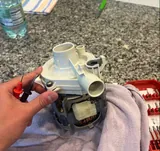
Draining is the job of a small electric pump, paired on most front-loaders with a lint and coin filter behind a panel at the bottom. Socks, coins, hair ties and bra wires jam the impeller or damage the pump seal. Once the water is out, the drive takes over. Older top-loaders use a motor, a coupler or belt, and a transmission; many newer machines use a direct-drive motor mounted on the back or bottom of the tub, with a position sensor that tells the board how fast the rotor is turning. A worn belt, a stripped coupler, a shifter that won’t change modes or a failed motor control circuit all show up as a washer that drains but never spins properly.
Spinning a wet load at high speed puts enormous force on the suspension. Top-loaders hang the tub on springs or rods with dampers; front-loaders use springs above and shock absorbers below. When those wear, the machine bangs, walks and shuts down on an out-of-balance error. Behind or beneath the drum, a pair of bearings and a seal carry the whole load, and once water gets past the seal the bearings rust and start to roar. Front-loaders add a rubber door boot that can tear, fold or grow mold, and every modern washer uses a lid switch or a door lock that must confirm it is closed before the cycle can continue.
The controls tie everything together. A main board reads the sensors and switches the valve, pump and motor, and on many front-loaders it also drives the motor through its own inverter circuit. A separate user interface board handles the buttons and display. Boards fail from power surges, heat and moisture, but they get blamed far more often than they deserve, because a failed lock, sensor or harness connector can look exactly like a dead control. That is why the technician checks the inputs and outputs a board depends on before recommending one, and why many washers that seem to have “dead brains” need a far smaller part.