A Magic Chef in this region is rarely the main kitchen appliance. It is the cube fridge under a dorm desk, the chest freezer in the garage holding a side of beef, the apartment-size top-freezer in an ADU kitchenette, the portable washer clamped to a kitchen faucet, or the narrow range in a granny flat. Most of these units are built from a short list of parts: a mechanical thermostat dial, a small compressor with a plug-on start relay and overload, a condenser on the back or hidden inside the cabinet walls, and very little electronics. Fewer parts means fewer things to go wrong, but each one has to carry more of the load.
On the cold side, three faults cover most calls. The first is a start relay or overload that clicks every few minutes while the compressor hums briefly and never settles into a run; the relay is inexpensive and is often the entire repair. The second is a thermostat with sticking contacts, which either freezes the lettuce or lets the cabinet drift warm no matter where the dial sits. The third is a sealed-system problem: the compressor runs on and on, yet the freezer plate stays bare and barely cool. That pattern usually means a refrigerant leak or a blocked capillary tube, and on a compact unit it is almost always the end of the road.
Nearly all Magic Chef mini fridges and chest freezers are manual defrost. There is no heater and no timer; frost simply grows on the evaporator until someone melts it off. Once that layer passes about a quarter inch it insulates the plate, the thermostat keeps calling for cold, and the unit looks broken when it really needs a thaw. Thick frost can also hold a door or lid slightly open, letting in humid air and speeding the whole cycle up. Before booking a visit for a warm compact fridge, look at the freezer shelf: a heavy white crust there is usually the whole explanation.
The laundry side behaves differently. Portable top-load washers fill through a quick-connect adapter on the kitchen faucet and drain through a hose hooked over the sink, so plenty of leaks begin at that adapter or a missing hose washer rather than inside the machine. Inside, the usual culprits are a lid switch that blocks the spin, a drain pump jammed by a sock or hair tie, a slipping drive belt, and an inlet screen choked with sediment. Compact dryers heat with a modest element, so a packed lint screen or crushed vent turns a long dry into a very long one, and repeated overheating eventually opens the thermal fuse.
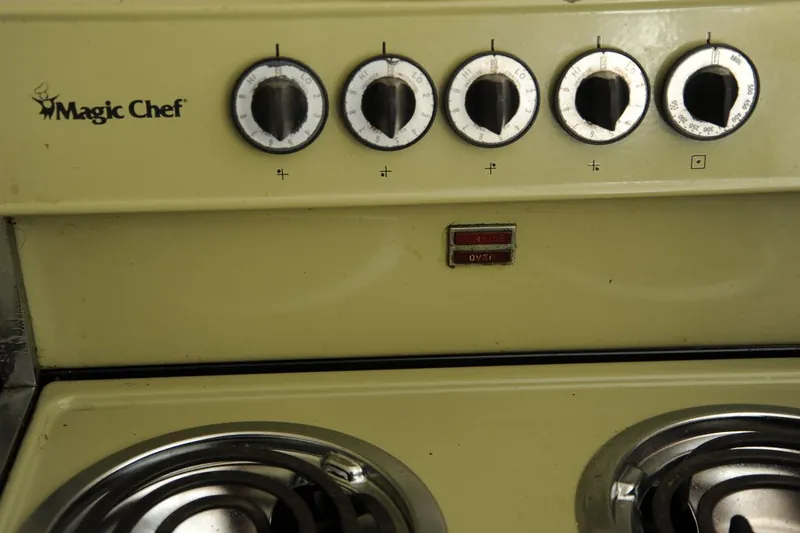
Magic Chef ranges are mostly narrow electric models, either coil or smooth-top, with an infinite switch behind each surface knob, a bake element, a broil element and a simple oven thermostat or temperature sensor. A coil that stays dead usually points to a scorched receptacle or a failed switch; an oven that heats but overshoots badly suggests the thermostat or sensor. Every job starts with the rating label, found on the back panel of most compact refrigerators and freezers, inside the lid or door frame of laundry units, and on the oven frame or behind the storage drawer of a range.