Most current LG appliances run on inverter-driven motors and compressors: a control board varies motor speed instead of simply switching a motor on and off. That design is efficient and quiet, but it also means the board is watching almost everything. When a sensor reading falls outside its expected window, the appliance stops and shows a short code such as OE on a washer, d90 on a dryer or Er FF on a refrigerator. The code tells you which system complained, not which part failed. A drain code can mean a clogged pump filter, a failed pump, a kinked hose or a sensor giving a false reading, and each fix is different. We treat the code as the starting point for testing, never as the answer.
LG refrigerators fall into a few platforms: French-door models with the ice maker in the left fresh-food door, side-by-sides, and InstaView and Door-in-Door versions that add a second outer door. Many use an inverter linear compressor, which is quiet and efficient but has been a known weak point on some model years. The usual complaints split three ways. A warm fresh-food section with a cold freezer points toward airflow or defrost. Both sections warming together points toward the compressor, its drive signal or the sealed system. Ice building up in the door ice compartment points toward a seal, fan or fill problem. Telling those apart takes temperature readings, fan checks and resistance tests.
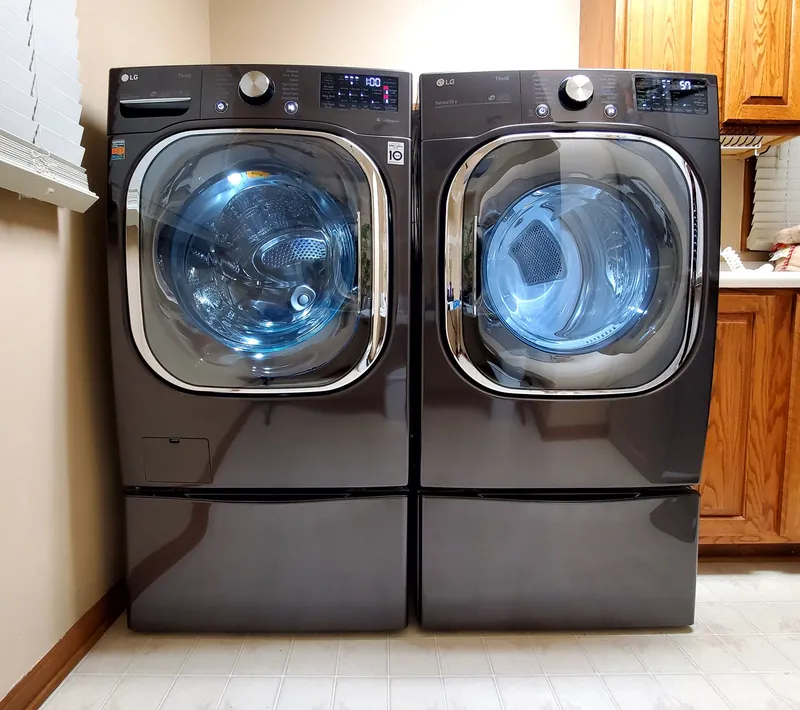
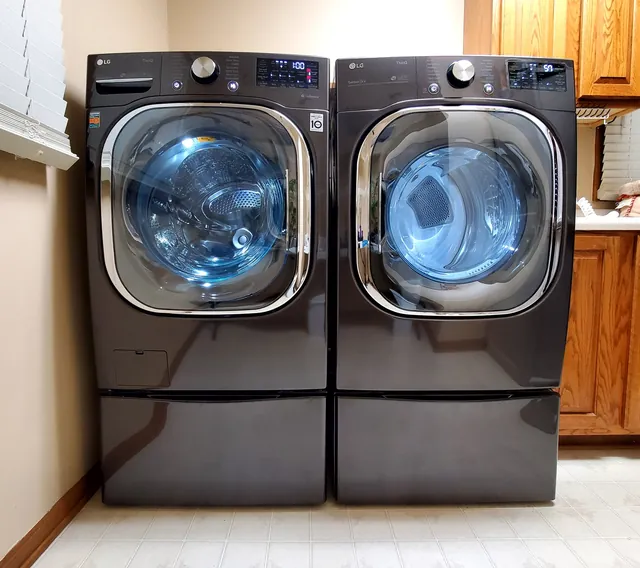
LG washers use a Direct Drive motor: a magnetic rotor fixed straight to the drum shaft, turned by a stator, with no belt or transmission. The motor rarely wears out as a whole, but its hall sensor, wiring and connectors can fail and produce LE or spin faults. Front-loaders add tub bearings, a door boot that traps moisture, shock absorbers and a drain pump with a filter; top-loaders add suspension rods and a lid lock. WashTower units put both machines in one frame with the controls in the middle. LG dryers are simpler: a belt-driven drum on rollers, an element or gas burner, thermistors and a moisture sensor. Their Flow Sense feature warns about restricted venting long before the dryer stops heating.
LG dishwashers, including QuadWash models, circulate water with an inverter direct-drive wash motor mounted in the sump under the tub. Most service calls there involve drainage and leak detection: a blocked filter or drain pump brings up OE, and water in the base pan lifts a float and shows AE. LG ranges come as electric smoothtops, induction, gas and dual-fuel, many with convection. On gas ovens the bake igniter weakens with age until the oven heats slowly or not at all. On electric models the usual failures are an element, a surface control or a relay on the control board. None of these require a new appliance by default.
Before a visit it helps to know exactly what you own. The model and serial label is inside the left wall of the fresh-food section on most refrigerators, around the door opening or on the back of washers and dryers, and on the side edge of the door or tub on dishwashers. LG model prefixes are readable: WM is a front-load washer, WT a top-loader, DLE an electric dryer and DLG a gas dryer. On most LG serial numbers the first digit is the last digit of the build year and the next two are the month, so a serial starting 305 was built in May of 2013 or 2023. Smart Diagnosis, in the older sound-based form or through the ThinQ app, can add a useful fault history.