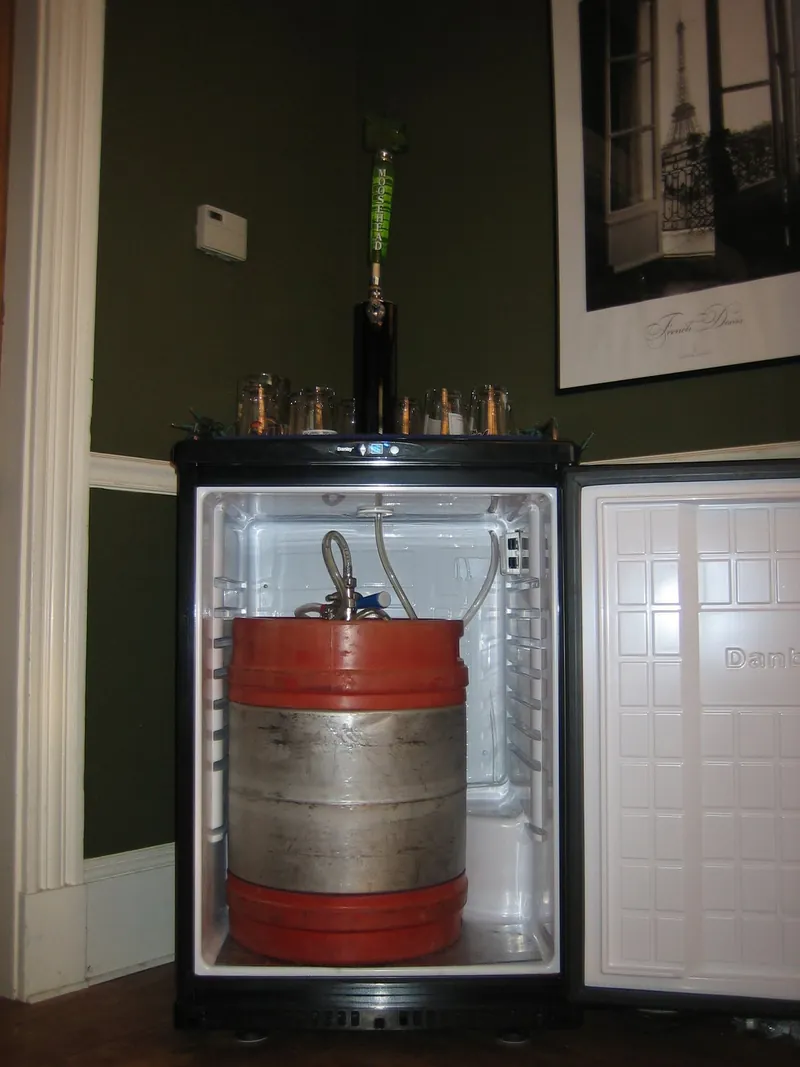
The biggest single factor in a Danby repair is where the unit lives. Danby builds freestanding models, which breathe through the back and sides, and built-in or under-counter models that pull and exhaust air through a grille at the front kickplate. A freestanding bar fridge or wine cooler slid tight into a cabinet opening recirculates its own hot exhaust, the compressor runs without a break, and the unit gets blamed for being weak. Many calls that sound like a dying compressor turn out to be a front grille blocked by a rug or a rear-vent unit boxed in by trim. Restoring airflow is sometimes the entire fix.
Most Danby wine coolers and beverage centers are compressor-cooled, working like a small refrigerator with an evaporator, a circulation fan and an electronic control that reads one or two temperature sensors. A failing fan shows up first as a display reading that climbs after each door opening and recovers slowly, then as a ticking or grinding noise behind the back wall. Dual-zone wine cabinets add a second sensor and a damper or heater, so one zone can drift while the other holds. If you own a thermoelectric model instead, it can only pull the cabinet a limited number of degrees below room temperature, and in a 90°F room it cannot hold cellar conditions even when healthy.
Danby compact refrigerators range from cube fridges with a small freezer compartment to two-door and apartment-size models with a separate freezer. Many compact models are manual defrost, so a warm complaint is often a thick frost layer rather than a failure. Chest freezers in the line are manual defrost as well, while some upright freezers defrost automatically with a heater, a timer or control board, and a sensor that ends the cycle. On a frost-free upright, one failed defrost part lets ice lock up the evaporator and fan, and the freezer warms slowly over several days, which is a very different job from a manual unit that simply needs a thaw.
Danby countertop dishwashers connect to the kitchen faucet with a quick-connect adapter and drain into the sink, which puts the most common leaks outside the cabinet: a worn adapter washer, a kinked fill hose or a drain hose that slips loose. Inside, they rely on a small wash pump, a drain pump, an inlet valve, a heater and a float or pressure device that tells the control when the tub is full. A countertop unit that hums but doesn’t spray often has a clogged filter or a pump jammed by broken glass or a fruit pit. Built-in Danby dishwashers follow the same logic with permanent plumbing and a door latch switch.
Compact laundry is a smaller share of Danby calls, but it follows a pattern. Small washers stop on a lid or door lock, or on a drain pump packed with lint and coins; compact dryers lose heat to a failed element or thermal fuse, often after months of running with a lint path that was never fully cleared. On every Danby unit the model and serial label is the starting point. On refrigeration it is usually on an inside side wall or on the back panel; on dishwashers it sits along the door edge or tub frame. The model number decides which control board, fan or valve fits, because lookalike units from different years often use different parts.