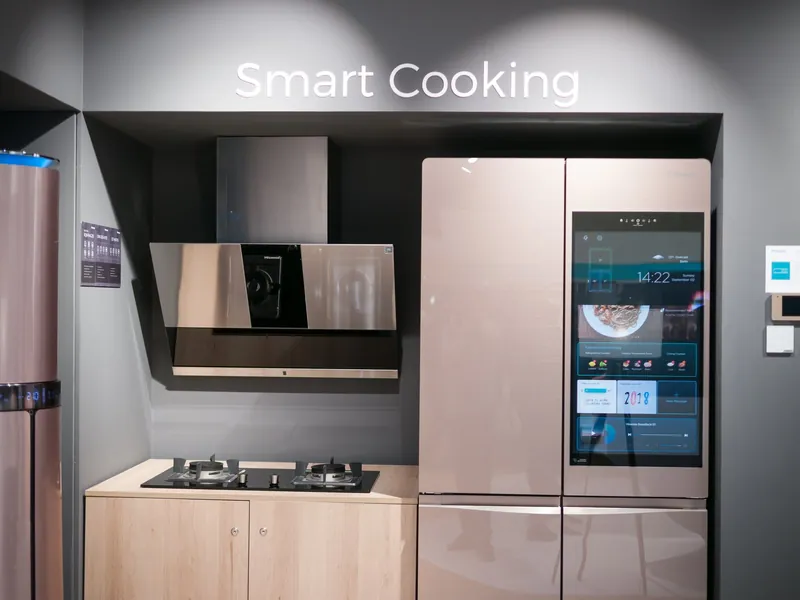
Refrigerators are the core of the Hisense appliance range in the US: French-door models in standard and counter depth, side-by-sides, top-freezer and bottom-freezer units, and compact refrigerators sized for offices, dorm rooms and bars. The larger frost-free models make cold air at a freezer evaporator, move it with a fan through ducts up to the fresh-food section, and melt frost away on an automatic defrost schedule. When a duct ices over, or the defrost heater or its sensor fails, the refrigerator side warms first while the freezer stays near normal. Some recent models also use a variable-speed inverter compressor, which changes how a weakening cooling system behaves: instead of clicking on and off, it simply runs longer and longer.
Hisense refrigerators with electronic controls rely on a set of thermistors: one in the fresh-food section, one in the freezer and one clamped near the evaporator to manage defrost. When a sensor reads open or shorted, the display shows a short code, and some models also flag a fan that is not turning. The code tables differ from platform to platform, so we look them up for the exact model rather than trusting a chart found online. A sensor fault is usually a small repair, but it can imitate a cooling failure, because the board makes every decision from the numbers it receives. That is why compartment readings are compared with a separate thermometer before a part is chosen.
French-door Hisense models with an ice maker and an outside dispenser add more moving parts: a water inlet valve at the back of the cabinet, a fill tube that can freeze, an ice maker module, an auger motor and a dispenser flap. Slow or hollow cubes usually point to low water pressure, an old filter or a valve that is starting to fail. A dispenser that drips suggests the valve or a filter not fully seated. Door gaskets and hinges deserve attention as well, since a door that does not close square lets humid air in, and the result is frost on the evaporator, sweating along the trim and a compressor that hardly ever rests.
Hisense laundry centers on front-load washers and matching dryers. The washers fail where front-loaders usually do: a drain pump clogged with lint, coins or a small sock, a door lock that will not confirm closed, a door seal that collects water and mildew, and an inlet valve that fills slowly. Unbalanced-load warnings on nearly every cycle point toward worn shock absorbers or a machine standing out of level. The dryers come down to heat, airflow and drum wear. Hisense dishwashers are 24-inch built-in units, and drainage, heating and door latch faults lead the list there, with a neglected filter often turning out to be the whole problem. On each of these, the code narrows the circuit and the meter names the part.
Noise is a frequent reason Hisense owners call, and it is often useful evidence. A buzz or click from the back that repeats every few minutes can be the compressor trying and failing to start. A rhythmic ticking inside the freezer is commonly a fan blade brushing frost, which means the defrost system has already fallen behind. Gurgling and soft cracking are normal refrigerant and plastic sounds. On inverter models, a compressor that ramps up and stays at high speed for hours is saying the cabinet cannot reach its set point, so blocked airflow, a dirty condenser and a leaking door are ruled out before anyone blames the compressor or its drive board.