Laundry is where Whirlpool generations show most clearly. The oldest machines we still service are direct-drive top-loaders built from the 1980s into the mid-2000s: a reversible motor bolted to a gearcase, a plastic-and-rubber coupler between them, and a pump hung on the motor shaft. They are simple and cheap to keep alive. Later the company moved to high-efficiency designs, first the Duet front-loaders and Cabrio top-loaders, then the vertical-modular platform with a motor mounted straight under the tub and a shift actuator to change between wash and spin. Each generation has its own short list of weak points, and knowing which one sits in the garage decides where the diagnosis begins.
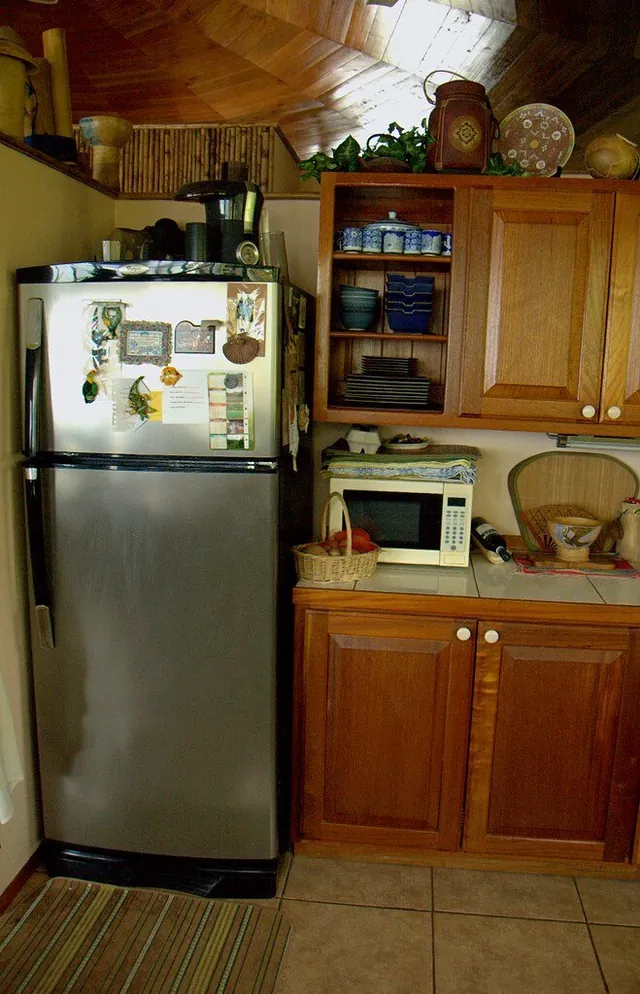
Whirlpool refrigerators, whether side-by-side, French-door, bottom- or top-freezer, mostly share one idea: a single evaporator in the freezer that also cools the fresh-food section through a duct. That design explains the complaint we hear most, a warm refrigerator beside a freezer that still feels cold. When a defrost heater, defrost thermostat or control stops melting the frost, ice chokes the coil and the air path, and the fresh-food side suffers first. Dispensers bring their own list: water inlet valves, frozen fill tubes, ice maker modules and, on many French-door models, an ice compartment inside the fresh-food door that frosts up when its seal or duct leaks.
Whirlpool-built dishwashers go into kitchens under the Whirlpool, KitchenAid, Maytag, Amana and JennAir names, so the sump, pump and motor under the tub are often identical across brands. Older units ground food with a chopper and flushed a self-cleaning screen; most models from roughly the early 2010s onward rely on a two-part filter the owner lifts out and rinses. When that filter is ignored the symptoms look mechanical, with gritty glasses, standing water and odor, and a plain cleaning solves them. Genuine failures cluster around the drain pump, circulation motor, heating element, door latch and, on many recent models, a small diverter that alternates water between spray arms.
Dryers and ranges round out the list. Whirlpool-built dryers are among the most repairable machines in any home: drum rollers, the idler pulley and the belt wear slowly and announce themselves with thumping or squealing, while heat problems trace to an element, gas valve coils, an igniter or one of the thermal safety devices that open when venting is poor. Electric and gas ranges fail at bake and broil elements, igniters, oven temperature sensors and control boards. Across every category the pattern holds: moving parts and heat-cycled parts fail first, and the electronics controlling them last longer when power is clean and airflow is good.