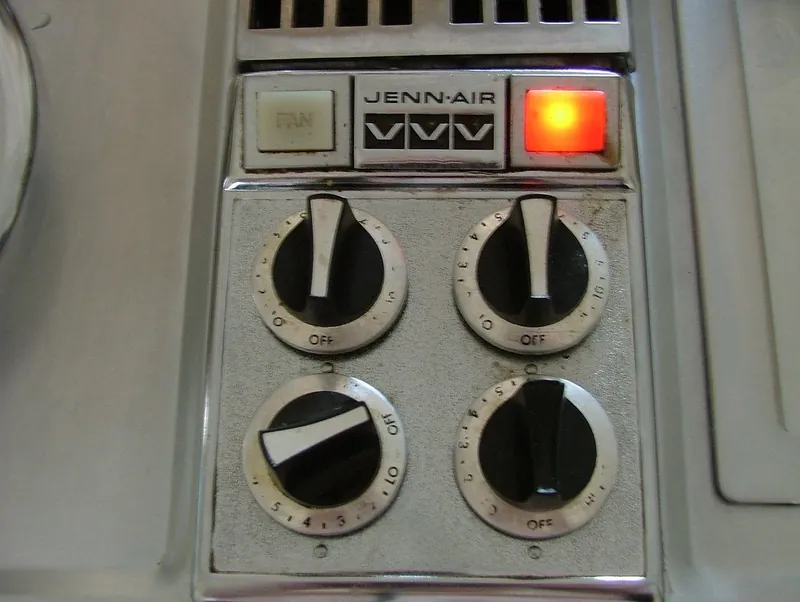
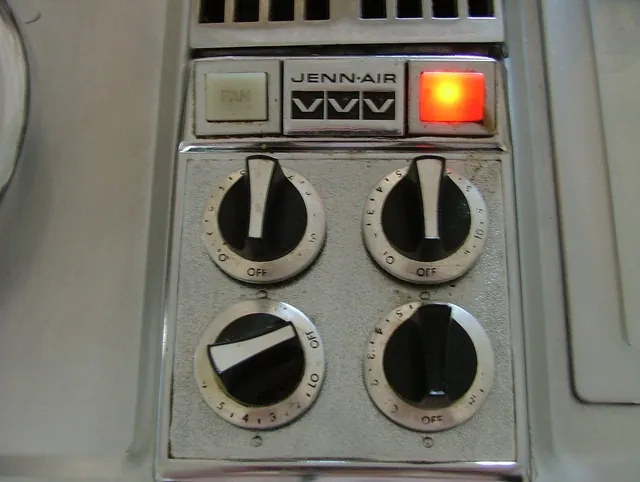
The brand began in Indianapolis around one idea: pull cooking smoke down through the cooktop instead of up into a hood. Downdraft ranges and cooktops, some with interchangeable grill, griddle and burner cartridges, made the old hyphenated Jenn-Air name, and many still cook in Sacramento kitchens finished in the 1980s and 1990s. Maytag bought the company in the early 1980s, and it came to Whirlpool along with Maytag in 2006. That history means a JennAir in a local home may be a Maytag-era design with its own parts, or a current model sharing hardware with KitchenAid, and the model and serial plate, rather than the look of the appliance, tells us which.
Downdraft ventilation fails gradually, so owners often live with it for years. The blower sits low in the base cabinet or at the back of the range and pushes air through ductwork out a wall or down through the floor; grease on the filters, a caked blower wheel or a damper flap stuck at the outside wall cap cuts the draw until smoke rolls over the pan instead of disappearing. Motors develop a hum or a grinding bearing. On the telescoping vents that rise behind a cooktop, the lift motor, its gear track and the limit switches wear, and spills that run down the slot jam the mechanism. Older modular cooktops add worn cartridge contacts, which overheat and pit much like a loose plug.
Wall ovens and ranges produce most current JennAir service calls. Convection is standard on many models, so the convection element and fan motor join the usual bake and broil elements, temperature sensor and door lock on the list. The controls usually sit just above the oven cavity, and in a double wall oven two cavities share one cabinet of heat; when the cooling fan weakens, that heat bakes the electronics, and the first sign can be a display that blanks or a door that stays latched after self-clean. Gas and dual-fuel ranges add spark modules, electrodes and hot-surface igniters, and some pro-style burners relight automatically when a flame blows out, a job handled by that same spark system.
JennAir refrigeration runs from freestanding French-door models closely related to KitchenAid units to fully built-in side-by-side and bottom-freezer refrigerators and the column line, where separate fresh-food, freezer and, in some kitchens, wine columns stand side by side behind matching panels. Built-in units differ where it counts for service: depending on the design, the machine compartment is reached through a grille at the top or a toe-kick at the base, and a condenser there clogs with dust and warms the box on hot days. Ice makers, water valves, evaporator fans and defrost components fail much as on other Whirlpool-family units, while hinges and door closers carry the weight of custom panels and loosen until a door no longer seals.
JennAir dishwashers are built on Whirlpool’s premium dishwasher platform, with stainless tubs, third racks and, on many models, controls hidden along the top edge of the door. Mechanically they share the sump, circulation and drain pumps, heater and diverter with KitchenAid machines. Panel-ready models carry a wood panel that adds real weight to the door, so the door springs must be set for it; when they are not, the door drops open hard or will not stay closed, and the hinge cables or springs eventually snap. Leaks often trace to the door gasket, a loose spray-arm feed or the drain connection under the sink, and a slow drip can soak the subfloor beneath a built-in cabinet for weeks before anything shows.